Key takeaways
- Format: Solitary outdoor lifestyle scene with a direct question, 9:16 Story.
- Best for: Mental health and therapy brands reaching men or people who rarely open up.
- Hook: A direct personal question that most viewers can't answer comfortably.
- Reuse it: Place your audience in their own comfort zone and ask one honest question about their feelings.
Available sizes
What is a lifestyle ad?
A lifestyle ad shows the product being used in a real setting by the kind of person who buys it. Instead of listing features, it sells the feeling or outcome of owning the product, which makes it a strong fit for fashion, home, travel and wellness brands.
See all lifestyle ads →Why this lifestyle ad works
- 01
Meets men where they are
Fishing is a familiar, low-key hobby where many men spend quiet time alone. Using it makes the ad feel relevant rather than preachy.
- 02
A question that sticks
"When's the last time…" makes viewers search their memory, and the uncomfortable answer is the hook.
- 03
"Actually" adds honesty
"How you actually felt" contrasts real feelings with the usual "I'm fine". That one word makes the message feel personal and true.
- 04
Calm, not crisis
The peaceful mist and stillness avoid sad or dramatic imagery. The tone invites reflection instead of signalling an emergency.
Full creative breakdown
Who this ad targets
Men aged about 30–60 in the US who rarely talk about their emotions, may see therapy as "not for them", and spend time on solo outdoor hobbies such as fishing, hunting or hiking. They may feel stress, isolation or pressure but default to keeping it in. A private, text-based AI app with no appointments can feel more approachable to them than a therapist's office. The ad can also reach partners and family who recognise this pattern in someone close to them.
Copywriting analysis
The headline is a question, "When's the last time you said how you actually felt?", which is harder to scroll past than a statement because it asks for an answer. "When's the last time" invites a memory search, and for the target audience the honest answer is often "I can't remember", which creates a moment of self-recognition. The word "actually" separates real feelings from polite small talk. The copy never says "therapy", "mental health" or "men", so it avoids stigma and doesn't single anyone out. The sign-off "Talk to Tee, 24/7." is the consistent campaign line, giving a simple, low-pressure next step. The tone is calm, direct and respectful, more like a friend asking than an ad selling.
Visual design
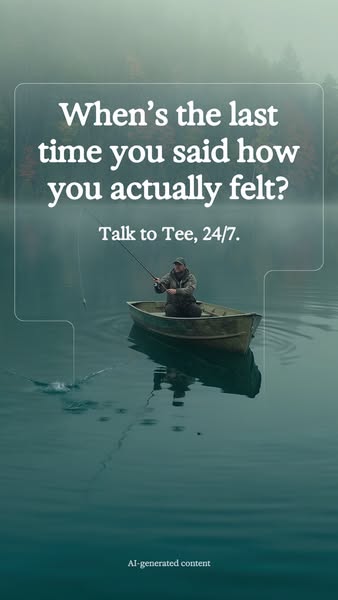
The misty green-grey palette and still water create a quiet, contemplative mood that matches the brand's teal colour system. The boat sits in the lower-middle of the frame, leaving the upper third clear for the text frame. Ripples around the boat link visually to the campaign's abstract ripple ad. The thin outlined frame with its tail motif keeps the ads recognisable as a series. Soft focus in the background and natural light make the AI-generated scene feel real.
How to adapt this template for your brand
- Pick a hobby or setting where your target group spends time alone, such as a garage, gym or trail.
- Show one person in a calm, natural pose, not looking sad or distressed.
- Write a direct question starting with "When's the last time…" about an emotional behaviour.
- Avoid stigma words like "therapy" or "mental illness" in the headline.
- Close with a simple sign-off that offers an easy, private next step.
Tips for therapy platforms ads on Meta
Run on Meta Stories and Reels, and test 4:5 Feed crops for older male audiences who use Facebook Feed more. Use interest targeting around outdoor hobbies (fishing, hunting, camping) rather than any health-based signals. Keep copy free of assumptions about the viewer's mental state to comply with Meta's personal attributes policy. Keep the AI disclosure on photoreal generated images. Pair with a landing page that explains privacy clearly, since that's the biggest worry for this audience.
About this creative
This vertical Story ad for Tee shows a middle-aged man in a cap and outdoor jacket sitting alone in a small wooden rowboat, casting a line on a still, misty lake surrounded by dark pine trees. The colour palette is soft, foggy green and grey, and gentle ripples spread from the boat and the line across the water. In the upper third, a thin rounded frame holds the white serif question "When's the last time you said how you actually felt?" followed by "Talk to Tee, 24/7." The frame's outline extends down the side like a speech-bubble tail, consistent with the rest of the Tee campaign. A small "AI-generated content" label sits at the bottom. The setting is solitary, calm and traditionally masculine, which makes a vulnerable question feel safe to consider. The ripples in the water echo the abstract ripple ad in the same series.
Meta ad · 338 × 600 · Therapy Platforms
Therapy App Ad: "When's the Last Time You Said How You Felt?"
This 9:16 lifestyle Story ad for the AI listening app Tee shows a man fishing alone from a rowboat on a misty lake, paired with a direct question about expressing feelings. It's a smart template for mental health brands trying to reach men, who are often hard to engage with emotional messaging.
Added
All brand names and logos are property of their owners. Adplaylist is not affiliated with or endorsed by these brands.
Details
Ad copy
Primary text
Plenty of us keep it all in. Tee gives you a private place to say how you really feel, whenever you're ready.
Description
No appointments. No judgment. Just talk.
On-image text
When's the last time you said how you actually felt? | Talk to Tee, 24/7. | AI-generated content
Headline ideas for this template
- 1"I'm fine" isn't a feeling.
- 2You don't have to keep it all in.
- 3Some things are easier to type than say.
- 4Quiet out here. Loud in your head?
- 5Talk it out. Nobody else has to know.
Meta image ad specs
| Placement | Ratio | Size (px) |
|---|---|---|
| Feed | 1:1 or 4:5 | 1080×1080 / 1080×1350 |
| Marketplace | 1:1 | 1200×1200 |
| Messenger inbox | 1:1 | 1200×1200 |
| Stories & Reels | 9:16 | 1080×1920 |
This template is 1:1. Request 4:5 or 9:16 to cover all placements.