Key takeaways
- Format: Ingredient-style comparison plus a fake search autocomplete
- Best for: Clean-ingredient, natural or chemical-free product positioning
- Hook: 'Your toilet paper: chlorine, fragrance, formaldehyde.' – a shock ingredient list
- Reuse it: Compare a competitor's 'ingredients' with your one simple ingredient
Available sizes
What is a comparison ad?
A comparison ad sets the product against an alternative, such as a competitor, the old way of doing things or a cheaper option, usually in a two-column layout or table. It helps buyers who are already weighing options see quickly why this one is the better choice.
See all comparison ads →Why this comparison ad works
- 01
Ingredient contrast
Listing three chemical-sounding words against one simple word, water, makes the choice feel obvious. It borrows the clean-beauty playbook.
- 02
Parallel structure
The 'Your X: … Your Y: …' format is easy to read and remember. The short answer 'water' lands as a punchline.
- 03
Search bar humour
Fake autocomplete suggestions feel familiar and funny. They imply popular demand without making explicit claims.
- 04
Relatable model
The woman's sceptical look mirrors the viewer's reaction to the ingredient list. It adds emotion to a factual message.
Full creative breakdown
Who this ad targets
US adults aged 22–40 who care about clean ingredients and read labels on skincare, food and household products. They are open to switching away from conventional products when they learn about chemicals or fragrances. Women with sensitive skin or those already in the clean beauty space are a core audience. Humour-loving social media users who enjoy search-bar and meme formats are a secondary segment.
Copywriting analysis
The headline uses a two-part parallel structure: 'Your toilet paper:' followed by three alarming ingredients, then 'Your TUSHY bidet:' followed by one calm word. The contrast between three and one makes the bidet feel pure and simple. Words like chlorine and formaldehyde trigger a clean-ingredient instinct. The search box copy uses autocomplete phrases that escalate from playful ('should be canceled') to persuasive ('should buy a TUSHY Bidet'), ending on the brand. It is persuasion disguised as a familiar internet joke.
Visual design
Terracotta tiles and warm lighting create a cosy, editorial bathroom that matches TUSHY's lifestyle photography. The model is positioned in the lower half so the upper half is free for text. White headline text has strong contrast against the darker wall. The translucent search card with a magnifying glass icon instantly reads as a search engine UI. The overall palette is warm and consistent, keeping the frame calm despite a lot of text.
How to adapt this template for your brand
- List three unappealing 'ingredients' or downsides of the competitor or old habit.
- Contrast them with your product's single simple ingredient or benefit.
- Add a search bar UI with 'reasons why…' and four escalating autocomplete suggestions.
- End the autocomplete list with your brand name.
- Shoot a lifestyle photo where the model's expression reacts to the comparison.
Tips for bathroom ads on Meta
Be careful with ingredient claims: make sure they are substantiated, especially on Meta and Google, which review health-related claims. This creative works on Instagram Stories, Reels and TikTok. Test a version without the search bar to see if the humour helps or distracts. Pair with primary text that links to a page explaining toilet paper ingredients. Use clean beauty interest targeting for a strong match.
About this creative
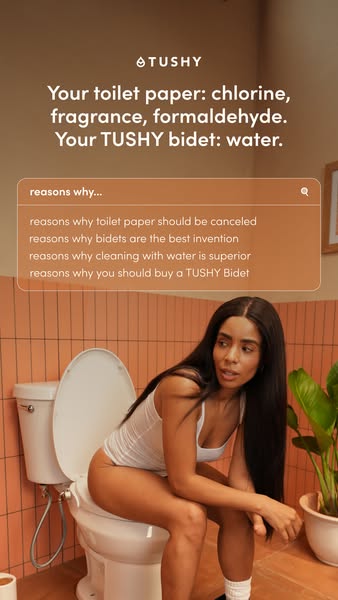
Set in a warm terracotta-tiled bathroom, the ad shows a young woman sitting on a toilet with a bidet hose attached, glancing sideways with a sceptical expression. A large plant softens the scene. The headline at the top reads 'Your toilet paper: chlorine, fragrance, formaldehyde. Your TUSHY bidet: water.' Beneath it is a semi-transparent search box styled like a search engine, with 'reasons why...' typed in and four autocomplete suggestions: toilet paper should be canceled, bidets are the best invention, cleaning with water is superior and you should buy a TUSHY bidet. The comparison uses an ingredient-list framing familiar from clean beauty marketing, making toilet paper sound like a product with hidden chemicals. The fake search suggestions add humour and imply that many people are already asking these questions, acting as subtle social proof.
Meta ad · 338 × 600 · Bathroom
TUSHY Toilet Paper vs Water Ad: Comparison Example
This TUSHY story ad sets up a blunt comparison – toilet paper's chlorine, fragrance and formaldehyde versus a bidet's plain water – then adds a playful search bar with autocomplete suggestions. Use it as a template for ingredient-based comparisons against a common competitor or old habit.
Added
All brand names and logos are property of their owners. Adplaylist is not affiliated with or endorsed by these brands.
Details
Ad copy
Primary text
Your toilet paper may contain chlorine, fragrance and formaldehyde. Your TUSHY bidet uses just one thing: water. It's time to rethink how you clean.
Description
Clean with water, not chemicals.
On-image text
TUSHY | Your toilet paper: chlorine, fragrance, formaldehyde. Your TUSHY bidet: water. | reasons why... | reasons why toilet paper should be canceled | reasons why bidets are the best invention | reasons why cleaning with water is superior | reasons why you should buy a TUSHY Bidet
Headline ideas for this template
- 1Your TP: Chemicals. Your TUSHY: Water.
- 2Clean With Water, Not Chlorine
- 3Read Your Toilet Paper Label
- 4The Cleanest Ingredient Is Water
- 5Reasons Why You Need a TUSHY
Meta image ad specs
| Placement | Ratio | Size (px) |
|---|---|---|
| Feed | 1:1 or 4:5 | 1080×1080 / 1080×1350 |
| Marketplace | 1:1 | 1200×1200 |
| Messenger inbox | 1:1 | 1200×1200 |
| Stories & Reels | 9:16 | 1080×1920 |
This template is 1:1. Request 4:5 or 9:16 to cover all placements.