Key takeaways
- Format: Native UGC selfie with first-person caption boxes
- Best for: Health, nutrition and wellness services with real customer stories
- Hook: A specific, honest number: My LDL was 178
- Reuse it: Pair any authentic customer photo with a two-box before-and-turning-point story
Available sizes
What is a UGC ad?
A UGC (user-generated content) ad looks like something a real customer posted: phone-quality photos, casual wording and a personal point of view. Because it blends into the feed and reads as genuine experience, it often earns more trust than a polished brand ad.
See all ugc ads →Why this ugc ad works
- 01
Feels like organic content
The mirror selfie and caption boxes mimic real TikTok and Instagram posts, so viewers don't skip it as an ad.
- 02
Specific numbers
Concrete figures for cholesterol and weight make the story feel credible and measurable.
- 03
Relatable inner voice
Telling myself it is what it is captures the resignation many people feel, building emotional connection.
- 04
Cost objection handled in-story
Insurance covered it all lands the key benefit naturally without sounding like a sales claim.
Full creative breakdown
Who this ad targets
This ad targets US adults, especially women aged 25–45, who have slowly gained weight or received concerning health markers such as high cholesterol and feel stuck. They are active on TikTok and Instagram, trust peer stories over brand claims and may already go to the gym without seeing results. The insurance angle appeals to people with commercial health plans who assume a dietitian is out of reach financially.
Copywriting analysis
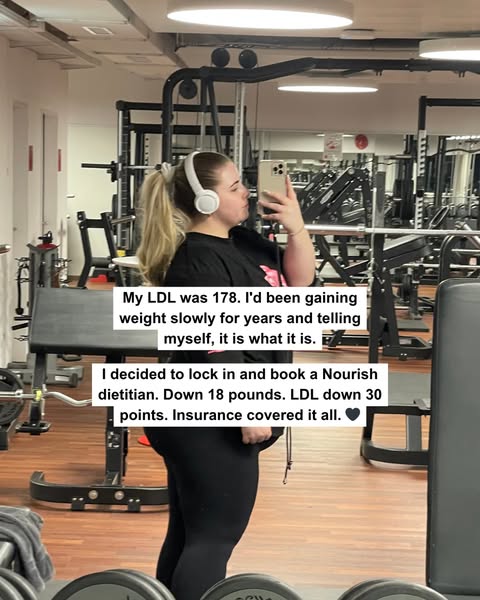
The copy follows a simple story arc in two captions. The first sets the scene with a vulnerable admission and a specific number, then adds an inner monologue line that feels honest. The second uses the casual phrase "I decided to lock in", popular on social media, to mark the turning point. Results follow in short, punchy fragments: down 18 pounds, LDL down 30 points. "Insurance covered it all" closes on the main benefit, and the heart emoji adds warmth. The first-person voice and brand mention mid-story keep it authentic. Results claims should be typical or clearly attributed to an individual.
Visual design
The visual is a raw, unedited-looking mirror selfie in a gym under bright overhead lights, which adds authenticity. The subject fills the frame vertically, with gym equipment in the background for context. Two white rectangular caption boxes with bold black sans-serif text sit in the center, styled like native TikTok text overlays. There is no logo, color branding or CTA graphic, so the creative relies fully on content and blends into organic feeds.
How to adapt this template for your brand
- Collect a real customer photo in a context that shows their new habit, like a gym or kitchen.
- Write the first caption box as the problem, with a specific number or honest feeling.
- Write the second box as the turning point with your brand name and concrete results.
- Use native TikTok or Instagram text styling instead of brand fonts.
- Get written consent from the customer and add an individual-results disclaimer in the primary text.
Tips for telehealth ads on Meta
On Meta, run this in Reels and Stories at 9:16 and in Feed at 4:5, and consider whitelisting it through the customer's account as a partnership ad. On TikTok, this style performs especially well as Spark Ads. Health ads should avoid implying the viewer has a condition, so keep personal claims in the customer's voice. Test the opening number hook against a different first line to find the strongest stopper.
About this creative
This portrait UGC creative for Nourish looks like a post from a regular social media user rather than an ad. A woman with a blonde ponytail and white headphones takes a mirror selfie in a gym, wearing black workout clothes, surrounded by racks and weights. The setting signals she is actively working on her health. Two white caption boxes in a TikTok-style font sit across the middle of the image and tell her story in first person. The first box sets up the problem: high cholesterol and slow weight gain she had accepted as normal. The second box delivers the turning point and results: she booked a Nourish dietitian, lost weight, improved her LDL and insurance covered it all, finished with a black heart emoji. The brand is mentioned only once, inside the story, which keeps it feeling genuine. There is no logo, button or polished design, so the creative blends into organic content and earns attention through relatability and honesty.
Meta ad · 338 × 600 · Telehealth
Dietitian UGC Testimonial Ad Template
This Nourish ad uses an authentic gym mirror selfie with TikTok-style caption boxes telling a personal story about working with a dietitian. The UGC format feels native in social feeds. Use it as a template for health and wellness services where a real customer story is more persuasive than polished branding.
Added
All brand names and logos are property of their owners. Adplaylist is not affiliated with or endorsed by these brands.
Details
Ad copy
Primary text
"I decided to lock in." Real results from working with a Nourish registered dietitian – and insurance covered it. See if your plan covers dietitian visits.
Description
Check your coverage in minutes
On-image text
My LDL was 178. I'd been gaining weight slowly for years and telling myself, it is what it is. | I decided to lock in and book a Nourish dietitian. Down 18 pounds. LDL down 30 points. Insurance covered it all. 🖤
Headline ideas for this template
- 1My LDL was 178. Here's what I did.
- 2I stopped telling myself it is what it is
- 3Down 18 lbs with a dietitian my insurance paid for
- 4The dietitian visit I didn't know was covered
- 5How I finally locked in on my health
Meta image ad specs
| Placement | Ratio | Size (px) |
|---|---|---|
| Feed | 1:1 or 4:5 | 1080×1080 / 1080×1350 |
| Marketplace | 1:1 | 1200×1200 |
| Messenger inbox | 1:1 | 1200×1200 |
| Stories & Reels | 9:16 | 1080×1920 |
This template is 1:1. Request 4:5 or 9:16 to cover all placements.
Browse similar by tag